
Upcoming Farmland Available For Rent
Will Saskatchewan Farmland Prices Keep Rising? A 2026–2030 Forecast
Probably yes — but more slowly than the recent boom. Saskatchewan farmland has risen for 30+ straight years and gained about 9.4% in 2025. Our base case for 2026–2030 is continued single-digit appreciation (roughly mid-single-digits to ~9%), not a repeat of the 2022–2023 double-digit surges. Four forces drive the outcome — the loonie, grain prices, interest rates, and farm cash flow — but they rarely all line up at once. The two that matter most are farm cash income and interest rates, not the exchange rate.
A popular idea is making the rounds among investors: the Canadian dollar is going to collapse to 60 US cents, and that will send Saskatchewan farmland soaring. It's an appealing story — a cheap loonie, booming exports, land prices to the moon. But is it true?
We took the four forces people cite most — a weak loonie, strong grain prices, low interest rates, and healthy farm cash flow — and tested them against 15 years of real data. The direction of each is right: individually, all four do support farmland prices. The catch is whether they actually happen together. This is our honest forecast for 2026–2030, with the numbers behind it.
Will the Canadian dollar really fall to 60 cents?
Let's start with the claim that kicked off the whole thesis. A widely-shared article argued the loonie could plunge to nearly 60 US cents, citing Canada's lagging productivity, trade uncertainty, and a widening interest-rate gap with the US. The reasoning isn't crazy — those are real pressures. But two things are worth knowing.
First, the analyst behind that call has since reversed it. The original "near 60 cents" forecast came from a research team that, months later, publicly turned bullish and set a target of 77 cents — before wavering again. When the author of a forecast no longer holds it, that tells you how uncertain currency prediction really is.
Second, and more important: no major bank forecasts 60 cents. The 2026–2027 consensus across Canada's big banks and international houses clusters around 74–77 cents — a modest recovery from current levels near 70 cents, not a collapse. The loonie has only briefly touched 60 cents once in modern history (2002). It is a low-probability tail scenario, not a base case.
Even at 60 cents, why farmland wouldn't soar
Suppose the loonie did fall to 60 cents. In the US or Australia, a cheap currency pulls in foreign buyers and bids up land. In Saskatchewan, that channel is blocked by law. The Saskatchewan Farm Land Security Act caps non-residents and non-Canadian entities at 10 acres — a fraction of a single 160-acre quarter section. Only Canadian citizens and permanent residents can buy without limit. A cheap loonie simply can't draw in foreign capital the way it does elsewhere.
So the only real channel a weak dollar works through is export income. Canadian wheat and canola are priced in US dollars, so a weaker loonie lifts the Canadian-dollar revenue farmers receive. Farm Credit Canada estimates that a 1% depreciation raises crop cash receipts by about 0.7%. That's a genuine support — but it's a cushion, not a rocket. And here's the crucial part: the macro events that would actually drive the loonie to 60 cents — an oil-price collapse, a deepening trade war, a recession — are themselves largely negative for the Saskatchewan economy and farm incomes. The tailwind and the headwind arrive together.
"A weak loonie helps most when it's cushioning farm income against soft global grain prices — not stacking on top of a boom. Its job is defense, not offense."
— ExtrAcre FarmlandThe history: the loonie and farmland don't move together
Here's the single most important chart for this whole debate. It plots Saskatchewan's annual farmland gains (bars) against the Canadian dollar (line) since 2010. If "weak loonie → farmland boom" were true, the two would move in opposite directions in lockstep. They don't.
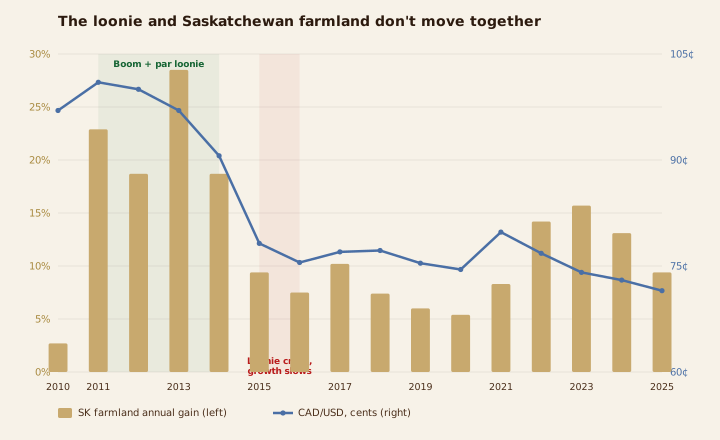
Look at the two shaded periods. In 2011–2014, Saskatchewan farmland exploded — up 22.9%, 18.7%, and 28.5% in consecutive years — but the loonie was sitting near one US dollar. The engine was a global grain super-cycle and record farm incomes, not a weak currency. Then in 2015–2016, the loonie crashed to about 68 cents after oil collapsed. If the weak-dollar thesis were right, farmland should have gone vertical. Instead, growth slowed to 9.4% and 7.5%, and the oil-heavy east-central region saw values flatten.
The lesson isn't that the loonie is irrelevant — in 2015 a weak dollar genuinely helped Canadian farmers dodge the price collapse that hit US farmers. But it worked by protecting income when grain prices were falling, not by adding fuel to a boom. Weak-loonie years and high-grain-price years are usually different years.
Will the four drivers line up in 2026–2030?
This is the real question. Each of the four forces supports farmland on its own. The issue is whether they'll happen together. Here's where each one actually stands in mid-2026.
| Driver | Effect on land | Status in mid-2026 |
|---|---|---|
| Weak loonie | Lifts CAD grain revenue (+0.7% per 1%) | Mildly weak (~70¢); expected to firm to 74–77¢ |
| High grain prices | Strongest driver — sets farm income | Not in place — canola & wheat below 2022 peaks |
| Low / stable rates | Low cap rate → higher land value | Stable at 2.25%; limited room to fall further |
| Strong cash flow | More bidding power at auction | Split — livestock strong, grain/canola weak |
Two of the four are solid: interest rates are stable, and livestock cash flow is strong. But the single most powerful driver — high grain prices — is not in place. Canola and wheat sit well below their 2022 highs. And Saskatchewan was the only province where total farm receipts fell in 2025, because gains in livestock couldn't offset weaker crop and canola income. The weak loonie is real but mild. So the "all four firing at once" scenario simply isn't today's reality.
What actually decides the next five years
If you take one thing from this article, make it this: watch farm cash income and interest rates, not the exchange rate. Farmland is a long-duration asset, so the capitalization rate — driven by interest rates — moves its value more than the currency ever will. And farm income, driven mostly by grain prices, determines what farmers can afford to bid. The loonie is a secondary, indirect factor.
The Bank of Canada held its policy rate at 2.25% through 2026 — a neutral, moderately-low level that supports land values. The risk is that input-driven or oil-driven inflation forces rates back up, which would compress land values regardless of grain prices or the dollar. This, not the exchange rate, is the variable to watch most closely.
Grain prices are the first driver of farm income and therefore of land. The 2026 news is mixed-to-positive: China cut its tariff on Canadian canola seed sharply (to about 14.9%) and dropped the tariff on canola meal to zero — a meaningful relief — though the tariff on canola oil remains. US biofuel demand adds upside. But global stocks are ample, so a return to 2022 peak prices is unlikely in the base case.
Livestock producers are flush; grain and canola farmers are squeezed between soft prices and high input costs. Because Saskatchewan is grain-and-canola heavy, the province's overall bidding power is currently softer than the national picture — something to watch as the tariff relief filters through.
The forecast: three scenarios for 2026–2030
Putting it together, here's how we see the next five years — with the base case in the middle.
| Scenario | Conditions | Likely SK farmland |
|---|---|---|
| Base case (most likely) | Loonie 70–77¢, grain prices firm modestly, rates stable, cash flow recovers | Continued single-digit gains, ~mid-single-digits to 9%/yr |
| Bull case | Global supply shock lifts USD grain prices and loonie stays weak (a 2022-style combo) | Double-digit gains return, but rare and short-lived |
| Bear case | Inflation forces rates up, and/or grain prices fall further with high input costs | Growth stalls; low-productivity regions could flatten |
Notice what the bull case actually requires: not just a weak loonie, but a global grain supply shock (war, drought, La Niña) pushing US-dollar prices up at the same time. That combination did briefly appear in 2022 during the Ukraine war — soaring grain prices, a strong US dollar, a weaker loonie all at once — but it's rare and doesn't last. Betting on it as your base case is betting on a coincidence.
The base case is more sober and, we think, more useful: Saskatchewan farmland keeps climbing, as it has for three decades, but at a single-digit pace rather than the double-digit surges of 2022–2023. That's still a strong real asset — a long-term inflation hedge with a rising income stream — just priced with realistic expectations.
"Your instinct is right that these four forces lift farmland. The correction is the premise: they rarely fire together — and when someone promises a boom, they're usually assuming a coincidence."
— ExtrAcre FarmlandWhat this means if you're buying
For investors, the practical implications are clear. Don't anchor your thesis to the exchange rate. If you're buying Saskatchewan farmland as a long-term hold, the currency is a second-order variable — a mild tailwind at today's levels, likely to fade as the loonie firms. What should drive your decision instead is the quality of the parcel, the strength of its rental income, and the price you pay relative to that income.
That's also where a cheap loonie does matter for one specific group: buyers holding US dollars or foreign capital who already have Canadian citizenship or PR status. For them, a weak loonie lowers the cost of entry — the same US dollars convert to more Canadian dollars of land. But note carefully: that's a cheaper entry point, not evidence the land itself will jump in value. And it only applies to those legally able to buy — the 10-acre cap on non-residents has no workaround.
Whichever camp you're in, the winning move is the same: buy good land at a sensible price relative to its income, and hold. Currency headlines come and go; soil quality and rental yield are what compound.
Will Saskatchewan farmland prices keep rising through 2030?
Most likely yes, but more slowly than the 2022-2023 boom. Saskatchewan farmland has risen for more than 30 straight years and gained about 9.4% in 2025. The base case for 2026-2030 is continued single-digit annual appreciation - roughly mid-single-digits to about 9% - rather than a repeat of the double-digit surges. The two variables that matter most are farm cash income and interest rates, not the exchange rate. A double-digit boom would require grain prices to jump while interest rates stay low, a combination that is possible but not the base case.
If the Canadian dollar falls to 60 cents, will Saskatchewan farmland soar?
No. First, no major bank forecasts the loonie falling to 60 US cents - the consensus for 2026-2027 is a recovery toward 74-77 cents. Second, even if it did fall, Saskatchewan law caps non-resident ownership at 10 acres, so a cheap loonie cannot draw in foreign buyers the way it does in the US or Australia. A weak dollar mainly helps by raising the Canadian-dollar value of US-priced grain exports (FCC estimates a 1% depreciation lifts crop cash receipts by about 0.7%) - a modest support, not a boom. And the macro conditions that would push the loonie to 60 cents, such as an oil-price collapse or trade war, are themselves largely negative for the Saskatchewan economy.
What drives Saskatchewan farmland prices the most?
Farm cash income (which sets what farmers can afford to bid) and interest rates (which set the capitalization rate on land) are the two strongest drivers. Grain prices feed directly into farm income and were the main engine of the 2011-2014 surge. The exchange rate is a secondary, indirect factor that works mainly by cushioning farm income when global grain prices are soft. Land supply, soil quality and long-term investor demand round out the picture.
Will interest rates or the exchange rate matter more for farmland in the next few years?
Interest rates matter more. Farmland is a long-duration asset, so its value is highly sensitive to the capitalization rate. The Bank of Canada held its policy rate at 2.25% through 2026, and the path from here - whether input-driven inflation forces rates back up - will affect land valuations more than the currency does. A weak loonie helps farm income at the margin, but a sustained rise in rates would compress land values regardless of where the dollar sits.
Thinking about buying Saskatchewan farmland?
Whether the loonie is at 70 cents or 77, the fundamentals of a good parcel don't change. Explore available farmland, or talk to our team about building a long-term position based on income, not currency headlines.