
Upcoming Farmland Available For Rent
Black, Dark Brown or Brown? Which Soil Zone Should You Buy In?
There's no objectively "best" zone. Black soil is the most fertile and most expensive, but shorter-season, bushier, and lower-yielding as a percentage. Brown soil is the driest and cheapest, but more open, efficient, crop-diverse, and potentially higher-yielding on rent. Dark Brown is the middle ground. The right choice depends on what you want: appreciation or income yield.
Saskatchewan is vast. So which region should you buy farmland in? For most investors, that's the very first question after deciding to invest — and the answer lives in three soil zones. Many people assume the answer is simple: "just buy the most fertile Black soil." But that's too simple, and it can steer you away from the land that actually fits your goals.
This is a neutral, side-by-side comparison across the dimensions that matter — terrain, climate, crops, and the economics — so you can decide based on your own goals.
1. Terrain: where they are, and what they look like
Here's the first counterintuitive point: fertility comes at a cost.
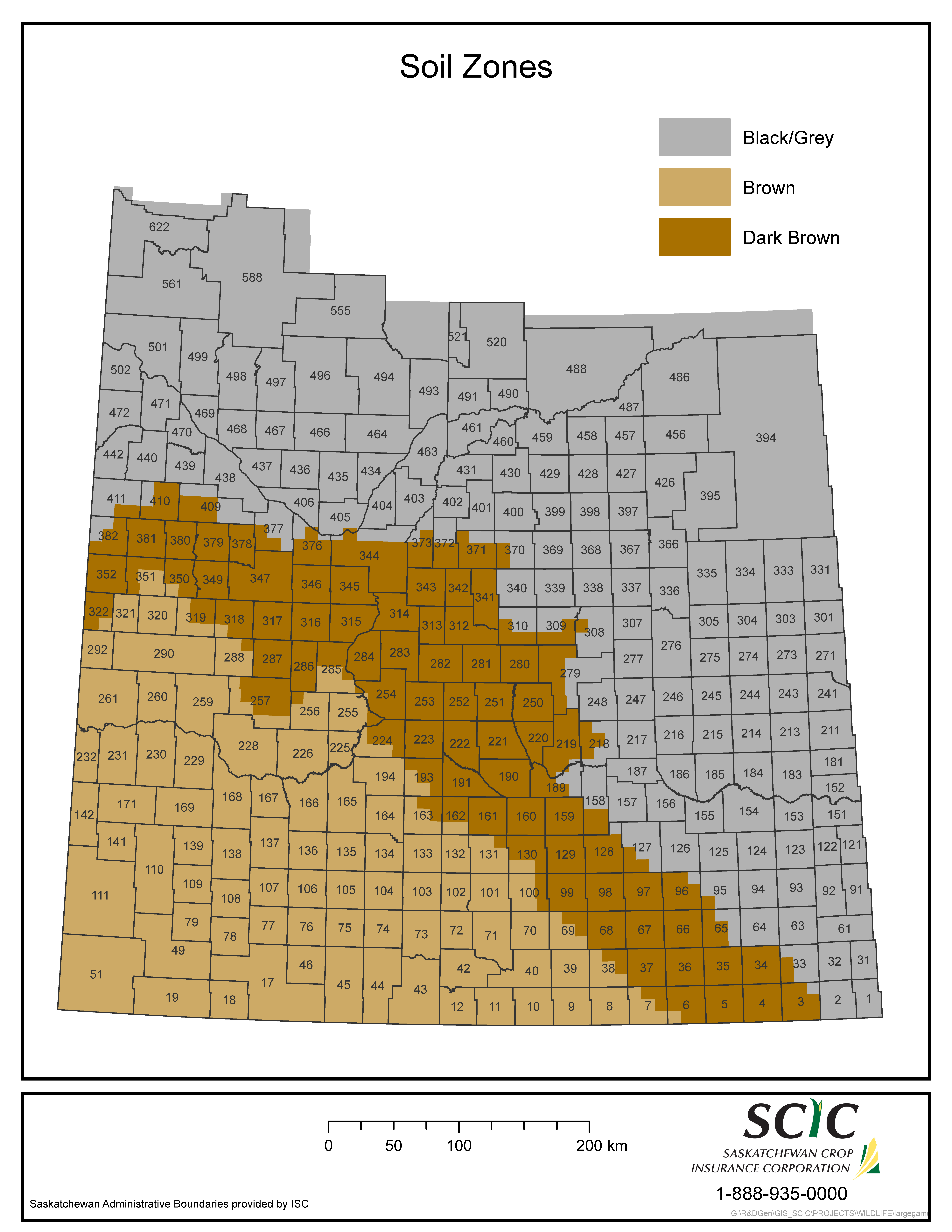
Black soil (east, northeast, northern parkland fringe) has the highest organic matter — but its higher rainfall brings more bush, trees, sloughs and low spots. Those non-farmable pieces fragment parcels, lower the cultivable acre percentage, and make large-machinery operations less efficient.
Brown soil (the drier southwest) is the opposite: because it's dry, it tends to be open, with fewer sloughs and less bush — giving whole, efficient parcels and higher field efficiency. Dark Brown sits in between. In short: Black soil buys you fertility; Brown soil buys you efficiency and completeness.
2. Climate: frost-free season, seeding and harvest windows
This is the most counterintuitive part of the whole comparison — the dry Brown zone actually has an advantage in the timing of farming.
Brown soil gets the least rain (roughly 300–350mm/year), but has the longest frost-free season and warmest base temperatures. That means lower early/late frost risk, wider seeding and harvest windows, and higher machinery utilization — more days a year to work comfortably.
Black soil is the reverse: more rainfall, but a shorter frost-free season and cooler base temperatures, so higher frost risk and narrower windows. Farmers in the Black zone are often racing the frost. Dark Brown sits in between on rainfall, frost-free days, and window width — a balanced transition zone.
"People fixate on how fertile the soil is, and forget to ask how many days a year you can actually work it. In Saskatchewan, time can be worth as much as fertility."
— ExtrAcre Farmland3. Crops: the breadth contrast
Since Brown soil has a longer frost-free season, the range of crops it can grow can actually be wider than fertile Black soil.
| Soil zone | Typical crops | Characteristic |
|---|---|---|
| Brown | Durum wheat, lentils, chickpeas, mustard, pulses | Long frost-free season → more specialty / longer-season crops, higher diversity |
| Dark Brown | Wheat, canola, pulses | Balanced crop mix, middle ground |
| Black | Canola, wheat, barley, oats (moisture-loving) | Fertile, but short season and narrow window limit some crops |
The counterintuitive point again: Brown soil, though drier and less fertile, can grow a wider range of crops — including high-value specialty crops like durum, lentils and chickpeas — while Black soil, though fertile, has a shorter season that limits some options. That said, fertility is a genuine Black-soil advantage: moisture-loving crops like canola yield high and stable there. It's not "which is better" — it's "each has its strengths."
4. The economics: rent, price, and rent-to-price yield
Terrain, climate, and crops describe how the land farms. This is how it invests — the three zones side by side.
| Metric (CAD/acre) | Black | Dark Brown | Brown |
|---|---|---|---|
| Cash rent | Highest ~$90–105 | ~$80–86 | Lowest ~$55–64 |
| Market price | Highest ~$4,000–4,700+ | ~$3,000–4,000 | Lowest ~$2,800–3,500 |
| Rent-to-price yield | Relatively lower | Middle | Potentially highest |
Here's the key insight hidden in that table: Black soil has the highest absolute rent, but because its land is also the most expensive, its rent-to-price yield can be lower. Brown soil has the lowest absolute rent, but because its land is cheap, its rent-to-price yield can be the highest.
That splits buyers into two camps. Those chasing appreciation favour Black soil — the top-quality asset, strongest long-term growth, worth a premium. Those chasing income yield favour Brown soil — cheaper land, higher yield percentage, more acres per dollar, lower entry point. Those wanting balance favour Dark Brown, which is mid-range on every metric.
So — which zone should you buy?
There's no "best" zone, only the one that fits your goals:
| If you want… | Consider | Why |
|---|---|---|
| Asset quality + appreciation | Black (east / northeast) | Highest-quality, most resilient, strongest long-term growth; you pay a premium for fertility |
| Yield + low entry point | Brown (southwest) | Higher rent-to-price yield, more acres per dollar, high field efficiency, lower entry cost |
| Balance + stability | Dark Brown (central) | Mid-range on fertility, price, yield, and climate risk — the steady choice |
Notice the answer never lies in "which zone is objectively best" — it lies in what you want. With the same budget, one buyer should buy Black and another should buy Brown. The difference isn't the land; it's the goal.
From choosing the zone to buying the right parcel
You now have a framework for that opening question. But remember: choosing the zone is only step one. Within a single zone, two neighbouring parcels can differ enormously in price and value — depending on SAMA soil rating, cultivable acre percentage, and parcel completeness. The zone comes from a framework; the parcel takes judgment.
Which Saskatchewan soil zone has the best farmland?
There's no single 'best' soil zone - only the one that best fits your goals. Black soil is the most fertile with the highest land price and rent and strong appreciation, but it has a shorter frost-free season, more bush and sloughs, lower field efficiency, and a narrower crop window. Brown soil is the driest and cheapest, but has a longer frost-free season, more open and efficient land, a wider range of possible crops, and potentially a higher rent-to-price yield. Dark Brown sits in the middle on every dimension. Choose Black for asset quality and appreciation, Brown for income yield and a lower entry point, Dark Brown for balance.
Is Black soil the best farmland to buy in Saskatchewan?
Black soil has the highest organic matter and is the most fertile and most expensive, but 'most fertile' doesn't automatically mean 'best investment.' The Black zone's higher rainfall brings more bush, sloughs and low spots, which fragment parcels and lower cultivable acreage and field efficiency. Its shorter frost-free season and cooler base temperatures mean higher frost risk and narrower seeding and harvest windows. So while Black soil is ideal for buyers seeking top-quality assets and appreciation, it isn't necessarily the best choice on field efficiency, crop breadth, or rental yield.
Which soil zone has the highest rent-to-price yield?
The Brown soil zone often has the highest rent-to-price yield. Although Brown-zone rent is the lowest in absolute terms, the land is also the cheapest, so annual rent as a percentage of land value can be higher than in the expensive Black zone. Saskatchewan's overall rent-to-price ratio is roughly 2.9%. For buyers focused on income yield rather than pure appreciation, cheaper Brown-zone land can offer a higher rental return percentage.
Which region of Saskatchewan should I buy farmland in?
It depends on your goals. For the highest-quality asset and strongest appreciation with a larger budget, choose the eastern and northeastern Black soil zone. For a higher rent-to-price yield, lower entry price and higher field efficiency, choose the southwestern Brown zone. For balance across every dimension, choose the central Dark Brown zone. Choosing the zone is only step one - picking the right parcel within a zone also requires judgment on SAMA soil rating and cultivable acres.
Choosing the zone is only the first step
Which zone depends on your goals; buying the right parcel within it takes local expertise. Meet the ExtrAcre team, or get in touch — we'll help you choose the right zone and buy the right land.