
Upcoming Farmland Available For Rent
How Much Does Farmland Cost Per Acre in Saskatchewan?
In 2025, Saskatchewan farmland typically ranges from about $2,800 to $4,700 per acre, with values up roughly 9.4% year over year. The most productive Black soil cropland in the east and northeast sits at the top of that range; drier Brown soil in the southwest sits at the bottom. Pasture sells for meaningfully less than cropland. But the price of your parcel depends on three things — region, land type, and soil — plus its SAMA rating and cultivable acres.
"How much does farmland cost per acre?" is almost always the first question a prospective buyer asks. It sounds simple — but there's no single answer. Saskatchewan farmland prices depend on three things: which region the land is in, what type of land it is (cropland vs. pasture), and which soil zone it sits in.
Compared with neighbouring Alberta and Manitoba, Saskatchewan farmland is often considered the best value per acre on the Prairies. Let's break the price down across all three variables — so you understand not just the number, but what drives it.
The province-wide picture
According to Farm Credit Canada's farmland values reporting, Saskatchewan farmland values rose about 9.4% in 2025 — following several years of strong, at times double-digit, annual gains (particularly 2021 through 2023). Over the past two decades, Saskatchewan farmland has appreciated roughly 11% per year on average, making it one of Canada's steadiest hard assets. For a buyer, that matters: this isn't a depreciating purchase, it's a long-term appreciating asset.
Price by region: the east-to-west gradient
Saskatchewan farmland prices follow a clear gradient — broadly decreasing from east to west.
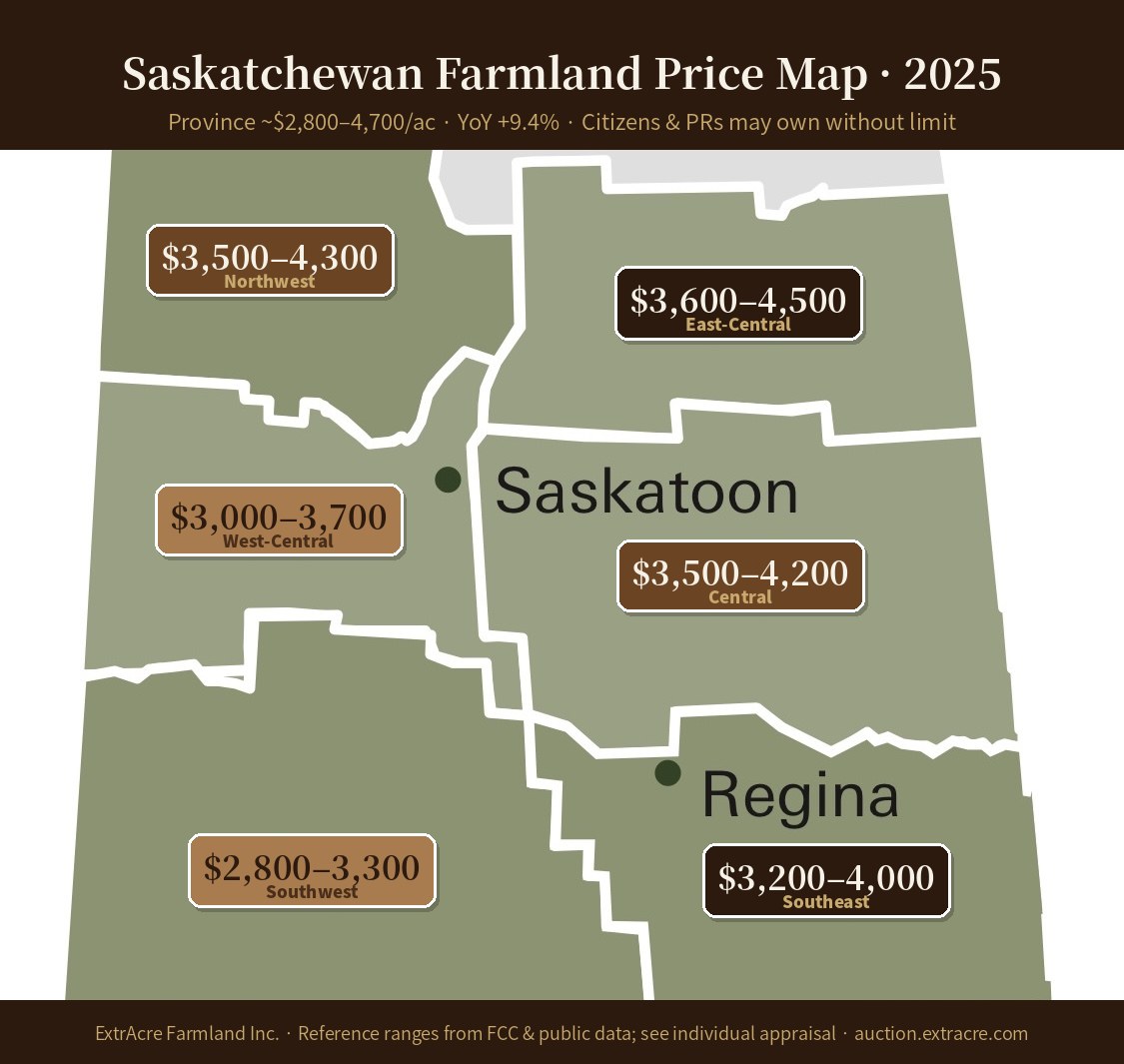
| Region (main towns) | Typical range (CAD/acre) | Soil zone |
|---|---|---|
| Northeast (Melfort / Tisdale) | Highest, ~$4,000–4,700 | Black |
| East-central (Yorkton) | ~$3,800–4,500 | Black |
| Central (Saskatoon / Humboldt) | ~$3,500–4,200 | Dark Brown / Black |
| Southeast (Weyburn / Estevan) | ~$3,200–4,000 | Black / Dark Brown |
| South-central (Regina / Moose Jaw) | ~$3,000–3,800 | Dark Brown |
| West-central (Kindersley / Rosetown) | ~$2,900–3,500 | Brown |
| Southwest (Swift Current) | Lowest, ~$2,800–3,300 | Brown |
The east and northeast are the most expensive; the southwest is the cheapest. The reason behind this gradient is soil and moisture — which brings us to the next layer.
Price by soil zone: the logic behind the numbers
Saskatchewan's regional price gradient is really a soil gradient. There are three main soil colours, and as a rule, the darker the soil, the more fertile — and the more expensive.
Black soil — highest priced
Found in the east, northeast, and northern parkland fringe. Highest organic matter, most reliable moisture, and the strongest productivity, so it commands the highest prices and is the most sought-after farmland in the province.
Dark Brown soil — mid-priced
The central transition zone (around Saskatoon and Regina). Moderate fertility and moisture, stable yields, and a middle-of-the-range price.
Brown soil — lowest priced
The drier southwest (around Swift Current). Lowest organic matter and highest moisture risk, so prices are lowest — but the entry cost is low, and with good management the land still has real value.
In one line: soil colour ≈ productivity ≈ price. (Saskatchewan also has a Gray wooded soil zone in the north, a forest-transition band that's less commonly cultivated — most buyers focus on the Black, Dark Brown, and Brown zones.)
Price by land type: cropland vs. pasture
Within any region, cultivated cropland and pasture carry very different prices — a distinction buyers often overlook.
| Land type | Price | Why |
|---|---|---|
| Cropland | Higher | Grows high-value crops; more income, cash flow and rental potential; strongest appreciation |
| Pasture (deeded) | Lower | Lower productivity, limited use (grazing/hay); lower entry price per acre |
Why is pasture cheaper? It comes down to output. Cropland can grow high-value crops and generate far more income per acre, while pasture can only be grazed or hayed. So per acre, privately-owned pasture typically costs a fraction of cropland. For a buyer chasing appreciation and rental yield, cropland is usually the better choice; if your budget is limited or you have a specific use, pasture's low per-acre price is its advantage.
What actually determines a parcel's price
Region, soil, and land type give you a range — but two parcels in the same region can still differ widely. These are the factors buyers should examine:
SAMA soil rating. The Saskatchewan Assessment Management Agency assigns each parcel a soil final rating — the official yardstick for productivity. The higher the rating, the higher the price, and it's the single most important objective measure of land quality.
Cultivable acre percentage. How many of the acres can actually be farmed? Parcels with bush, sloughs, or wet corners have a lower cultivable percentage, and a lower price. Clean, fully-farmable land is worth the most.
Moisture and climate determine yield stability, and are a core reason Black soil is expensive and Brown soil is cheap. Parcel size and proximity to roads and grain terminals raise efficiency and price. And market factors — commodity prices, interest rates, and institutional investor demand — move the overall level.
Who is eligible to buy Saskatchewan farmland?
An important point for any investor: under The Saskatchewan Farm Security Act, Canadian citizens and permanent residents can own Saskatchewan farmland with no acreage limit. Non-Canadian residents and foreign entities are restricted to a maximum of 10 acres. In other words, the restriction targets buyers who don't live in Canada and hold no status — not residents or citizens. (If your situation is unusual, confirm with a lawyer before purchasing.)
"In Saskatchewan, you're never just buying acres — you're buying a soil type, in a region, with a rating. The same dollar buys yield or it buys risk."
— ExtrAcre FarmlandFrom understanding price to buying the right parcel
You now have the full picture: roughly $2,800–$4,700 per acre province-wide, with eastern Black soil at the top and southwestern Brown soil at the bottom, cropland above pasture, and the specific price set by SAMA rating, cultivable percentage, and moisture.
But understanding price is only step one. Actually buying the right parcel means weighing region, soil, land type, SAMA rating, and cultivable acres together — which isn't easy for a buyer without an agricultural background. A cheap-looking parcel can be a bargain or a trap, and the difference is exactly where professional judgment earns its value.
How much does farmland cost per acre in Saskatchewan?
In 2025, Saskatchewan farmland typically ranges from about CAD $2,800 to $4,700 per acre, depending on region, land type, and soil zone. The most productive Black soil cropland in the east and northeast (around Melfort) reaches roughly $4,000-4,700+ per acre, while drier Brown soil land in the southwest (around Swift Current) is closer to $2,800-3,500. Privately-owned pasture sells for meaningfully less than cultivated cropland. Saskatchewan farmland values rose about 9.4% in 2025 and have appreciated steadily long term.
Which region of Saskatchewan has the cheapest farmland?
Generally the southwest (around Swift Current) and west-central (around Kindersley) Brown soil regions have the lowest per-acre prices, roughly $2,800-3,500, because these areas are drier with lower productivity. The eastern and northeastern Black soil regions (around Yorkton and Melfort) are the most expensive. The price gradient falls broadly from east to west, following soil quality and moisture.
Why does pasture cost less than cropland?
Privately-owned pasture and grazing land generally sells for significantly less per acre than cultivated cropland because cropland can grow higher-value crops and produce more income and cash flow, while pasture has lower productivity and more limited use. For buyers, cropland usually offers stronger appreciation and rental potential, while pasture offers a lower entry price per acre.
Can non-residents buy farmland in Saskatchewan?
Under The Saskatchewan Farm Security Act, Canadian citizens and permanent residents can own Saskatchewan farmland with no acreage limit. Non-Canadian residents and foreign entities are restricted to a maximum of 10 acres. So eligibility depends on residency/citizenship status, not on where a buyer originally came from.
Thinking about buying Saskatchewan farmland?
Understanding price is the first step — buying the right parcel takes local expertise. Meet the ExtrAcre team, or get in touch, and we'll help you find, understand, and buy the right land.