
Upcoming Farmland Available For Rent
What Is a Fair Cash Rent Per Acre for Farmland in Saskatchewan?
Based on 750+ real Saskatchewan farmland leases across 92 rural municipalities, the provincial benchmark cash rent is about $82 per acre per year, ranging from roughly $46 to $114. Black-soil regions in the east and northeast command the most ($88–102+); drier Brown-soil areas in the southwest are lower ($58–64). But a "fair" rent for your parcel depends on three things — soil, cultivable acres, and efficiency — and the only way to know it precisely is to test it against the market.
If you own farmland in Saskatchewan and rent it out, one question nags at you more than any other: am I getting a fair rent? It's a surprisingly hard question to answer here — and that difficulty is the whole reason this article exists.
Unlike some U.S. states, where the USDA publishes county-level cash rent surveys every year, Saskatchewan has no public farmland rent reporting system. There's no official table you can look up. Farm Credit Canada publishes land values, but not rents. So landowners — especially those who live out of province and rent to a local farmer — are often flying blind, with no independent way to check whether their rent is fair or years out of date.
This article closes that gap using real data: not estimates, but actual rents from 750+ competitive auctions and negotiated leases across the province.
So what is the fair cash rent per acre in Saskatchewan?
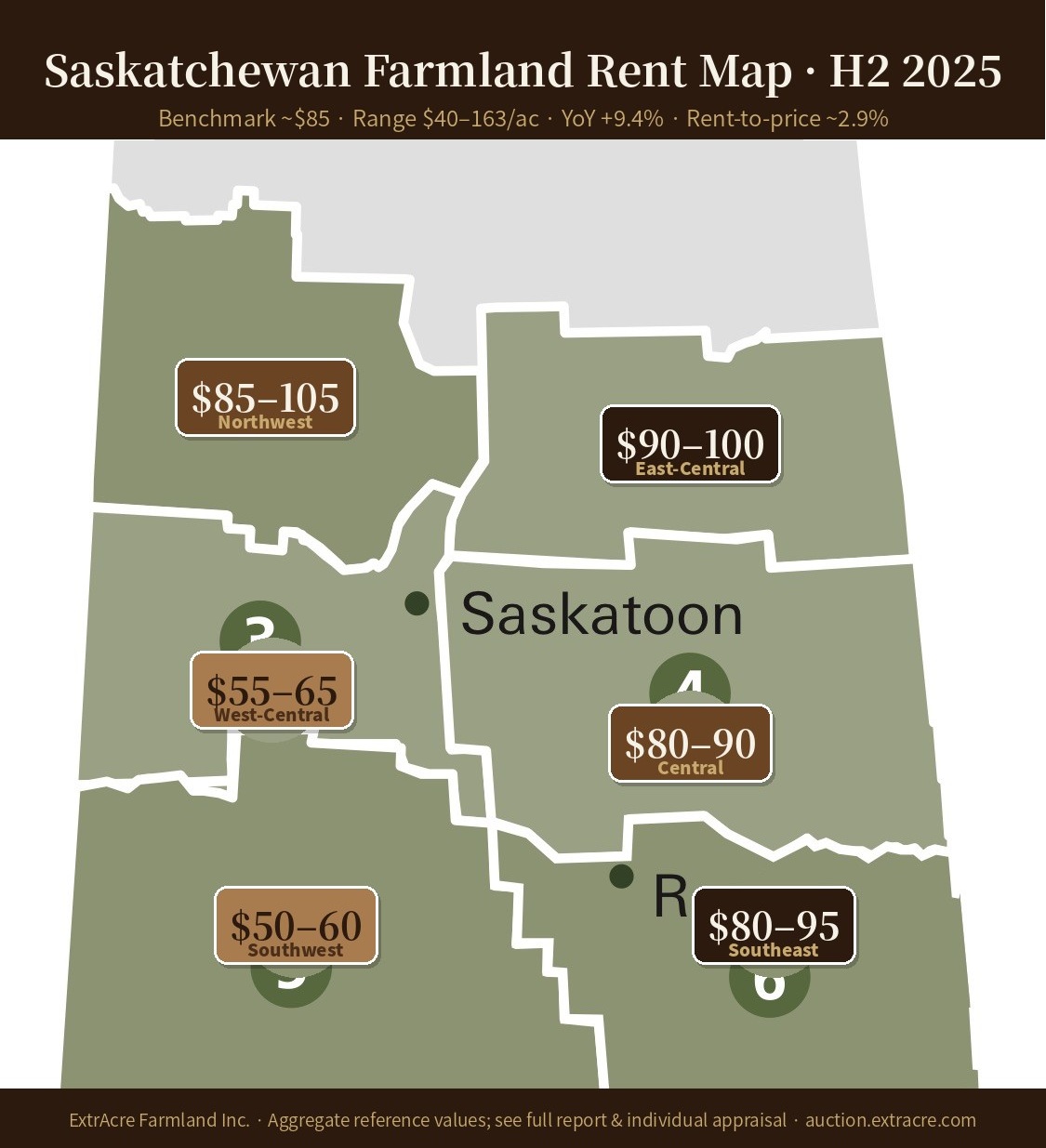
At the provincial level, the benchmark cash rent is approximately $82 per acre per year, with real rents ranging from about $46 to $114 per acre depending on where the land is and what kind of soil it sits on. As a rough map:
| Region / soil zone | Typical benchmark |
|---|---|
| Northeast & East-Central (Black soil) | $95–$102/acre |
| Southeast (Black soil) | ~$88/acre |
| Central & South-Central (Dark Brown) | $78–$84/acre |
| West-Central (Brown) | ~$64/acre |
| Southwest (Brown) | ~$58/acre |
The pattern is driven by soil. Saskatchewan's higher-productivity Black soil zone (much of the east and northeast) reliably grows more, so tenants bid more to farm it. The drier Brown soil zone in the southwest carries more moisture risk, so rents are lower — though land there is also cheaper, which is why its rent-to-price yield can actually be higher.
How is a fair cash rent actually calculated?
There are three common ways to arrive at a number. The first two are estimates; the third is the real test.
The most common approach expresses rent as a percentage of what the land is worth — the rent-to-price yield. In Saskatchewan this averages about 2.9%. So land worth $2,800/acre would rent for roughly $80/acre. It's a useful sanity check, but land values themselves vary widely, so this only gets you in the ballpark.
Another rule of thumb ties rent to a share of the gross revenue the land is expected to produce — often around one-third, depending on crop, price, and input costs. This links rent to productivity, but it depends on assumptions about yields and commodity prices that change every year.
The most accurate method isn't a formula at all — it's what qualified farmers will actually bid to rent the parcel. Estimates approximate; a competitive market reveals. When multiple tenants compete for the same land, they price in its real soil, its real workable acres, and its real efficiency far better than any rule of thumb can. This is exactly why a competitive rental auction tends to surface rents 10–30% above a quietly negotiated private rate.
Why do two farms in the same area rent for such different amounts?
A provincial or even regional benchmark is only a starting point, because within any given area, individual parcels can rent very differently. Three factors explain most of the gap:
Higher soil grades produce higher, more reliable yields — and command higher rent. Even within one rural municipality, a top-grade quarter can out-rent a marginal one substantially.
Rent is paid on productive acres. A quarter section with bush, sloughs, or wet corners has fewer workable acres than its title acres suggest — so its effective rent per title acre is lower. Clean, fully-cultivable land rents at the top of the range.
Large, square, obstacle-free fields let modern equipment work efficiently, so tenants can afford to bid more. Fragmented or irregular parcels cost more to farm and rent for less, even on good soil.
"A benchmark answers 'what does typical land in this region rent for?' A rental appraisal answers 'what does my specific parcel rent for?' You need both."
— ExtrAcre FarmlandHow do I know if my farm rent is too low?
This is the question that should keep absentee owners up at night — because the odds are stacked toward under-renting. Here's why: many Saskatchewan farmland leases are set privately, then quietly renewed year after year, sometimes for a decade or more, without ever being tested against the market. Meanwhile land values and crop prices climb. The rent quietly falls behind.
If any of these describe you, your rent may be below market:
The fix is straightforward: compare your rent to the regional benchmark for your soil zone, and if it looks low, test it. A free rental appraisal gives you an independent estimate; a competitive rental auction proves the real number by letting qualified farmers bid. Either way, you replace guesswork with evidence.
What is a fair cash rent per acre for farmland in Saskatchewan?
Based on 750+ real Saskatchewan farmland leases across 92 rural municipalities, the provincial benchmark cash rent is approximately CAD $82 per acre per year, ranging from about $46 to $114 depending on region, soil class, and cultivable acreage. Higher-quality Black soil regions in the east and northeast command roughly $88-102+ per acre, while drier Brown soil regions in the southwest are closer to $58-64 per acre. A fair rent for a specific parcel depends on its soil quality, percentage of cultivable acres, and parcel efficiency.
How is fair farmland cash rent calculated?
Fair cash rent is most often expressed as a percentage of land value (the rent-to-price yield), which in Saskatchewan averages about 2.9%. It can also be estimated as a share of expected gross crop revenue - commonly around one-third. The most accurate method, however, is the market itself: what qualified farmers will actually bid to rent the parcel. Soil class, cultivable acreage, and field efficiency then adjust the rate up or down.
How do I know if my Saskatchewan farm rent is too low?
Compare your current rent to the regional benchmark for your area and soil zone. Because Saskatchewan has no public rent reporting, many landowners - especially absentee owners - unknowingly rent below market. If your rent hasn't been tested against competing tenants recently, it may be below what the land would clear at a competitive rental auction. A free rental appraisal or a competitive auction reveals the true market rate.
Is your farmland renting for what it's worth?
Get a free, no-obligation rental appraisal based on your parcel's soil, cultivable acres, and location — and see how it compares to the regional benchmark.
Get a Free Rental Appraisal