A wet 2026 spring hit Saskatchewan's Black Soil Zone during seeding. With squeezed cash flow, low grain prices, and high fertilizer costs, where are fall rental rates headed? Our forecast: rents hold flat to modestly higher (0-4%), with Melfort near $105-109 and Yorkton near $98-102 - because farmland rent is sticky and the wet damage was localized, not region-wide.
If you own farmland in Saskatchewan's Black Soil Zone — the rich northeast and east running through Melfort, Yorkton, Nipawin and Carrot River — you watched the rain this spring with a knot in your stomach. Fields sat under water. Seeders stayed in the shed. And now, heading into the fall leasing season, the question is simple: what will your land rent for, and will farmers even want it?
Here's our honest, data-driven read. The damage was real — but it's more localized than the headlines suggest, and the forces that actually set farmland rent point to stability, not a drop.
How bad was the 2026 wet spring, really?
Real, but concentrated. The province's crop reports tell the story: by early May only 3% of the crop was seeded, against a five-year average of 12%. The east-central region was furthest behind — in one week Calder took 164 mm of rain, Foam Lake 110 mm. Seeders simply couldn't move.
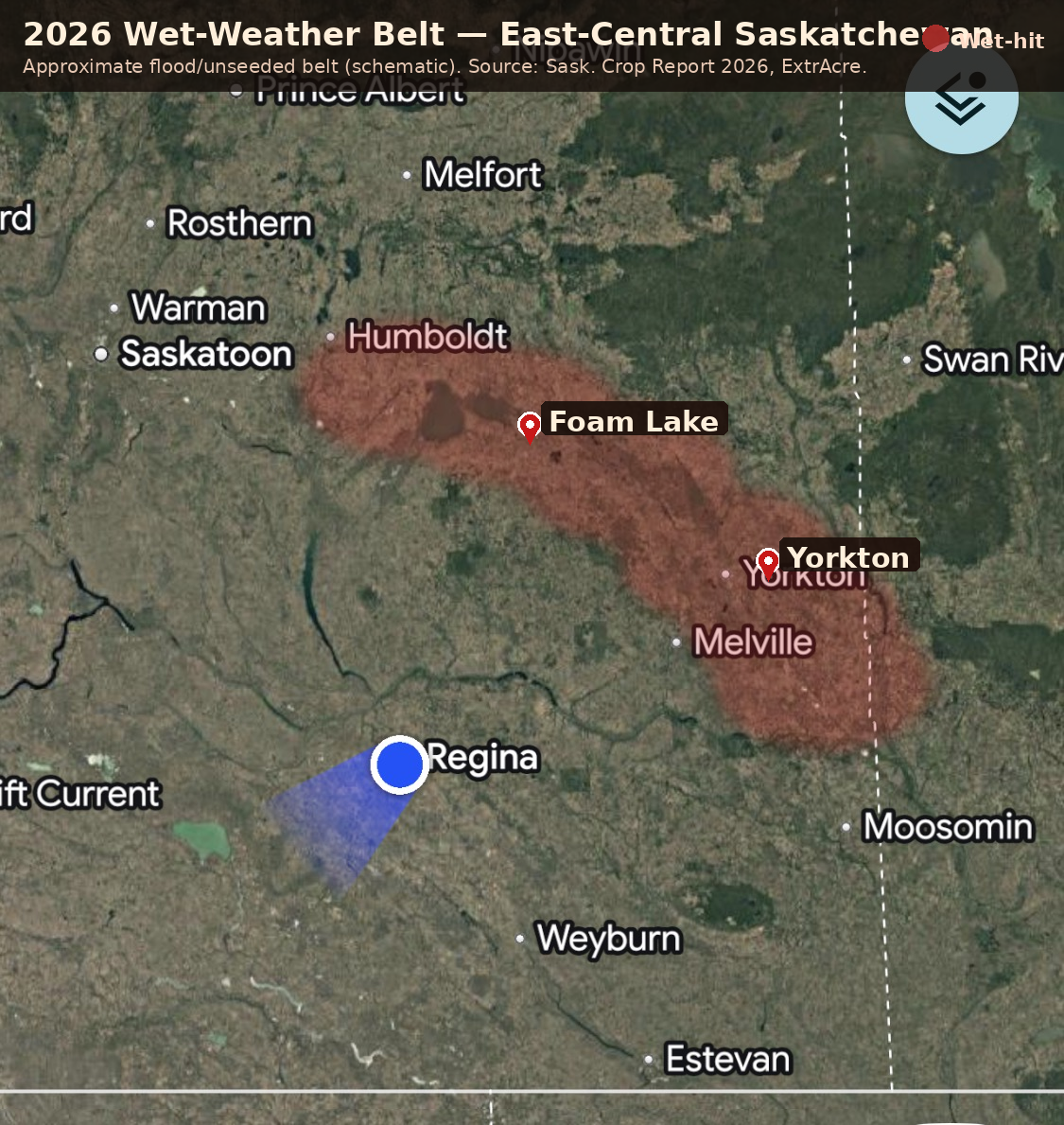
But then it dried enough to catch up. By late June the province reached 99% seeded. The lasting damage: about 3% of intended acres stayed unseeded (too wet), and roughly another 3% of seeded acres were flooded out. Crucially, one agronomist described the worst zone as a belt roughly 20–30 miles wide and 80 miles long in the east-central area — a serious hit for the farms inside it, but not a region-wide wipeout. Two-thirds of cereal crops still rated good, a quarter excellent.
Why rents don't drop in a bad year
It feels intuitive that a rough crop year should push rents down. The data says otherwise. Farmland rent is "sticky" — a word farm economists use over and over. It rises slowly when times are good, and it falls slowly (if at all) when times are bad.
The clearest proof is history. In 2010–2011, Saskatchewan saw far worse flooding than 2026 — up to half the northeast went unseeded, and millions of acres across the Prairies were abandoned. If wet years crushed rents, that's when it would have happened. Instead, Saskatchewan land values rose 22.9% in 2011 and 28.5% in 2013 — the biggest single-year jump since 1985 — and cash rents climbed right alongside. Even 2022, another wet east-central spring much like 2026, was followed by strong demand and rising values.
"Rents are notoriously sticky. They lag crop income on the way up, and they take time to come down too — sticky at both ends."
Three forces hold rents up even in a squeeze:
A large farm has already paid for its machinery, its labour, its overhead. Dropping rented acres doesn't shrink those costs — it just spreads them over fewer acres, raising cost per acre. So most operators would rather hold land through a bad year than give it up and hand an opening to a neighbour.
In the Black Soil Zone, good land rarely comes free. The moment a parcel is available, expansion-minded neighbours compete for it. Limited supply plus motivated bidders is a recipe for upward pressure, not a discount.
Saskatchewan Crop Insurance's unseeded acreage benefit pays $50–125 per acre. As one dealer put it, if you collect the unseeded payment, your only cost is diesel and keeping the field clean. That cushion — plus AgriStability and cash advances — keeps cash flow from cratering and reduces forced exits from rented land.
But cash flow is tight — so what gives?
Let's be honest about the squeeze, because it's real. Renters are caught between three pressures at once: localized crop losses from the wet spring, low grain prices (oats near $190/tonne, canola around $709, wheat around $287 at local elevators), and high input costs — Canadian farm input spending is projected near a record in 2026, with fertilizer alone close to $10 billion. Saskatchewan's realized net farm income actually fell about $1 billion in 2025, the largest drop in Canada.
So how do tight margins and stable rents coexist? The answer is that the squeeze shows up in behaviour, not in the headline rent number. Expect more caution: more "wait and see," fewer aggressive bidding wars, and a narrower auction premium — where auction rents typically run 10–30% above quiet private deals, this fall that edge may compress toward 8–20%. Bidder numbers soften; they don't vanish.
The forecast: three scenarios for fall 2026
Here's how we see the Black Soil Zone leasing season, with the base case in the middle.
Notice that even the downside is concentrated and shallow — flat to a few percent lower on the specific parcels that took the worst of the rain, not a zone-wide collapse. And the upside is live: China cut its canola-seed tariff to a combined 14.9% effective March 2026 (down from near 85%) and dropped canola meal to zero for the year. If that relief reaches cash prices this fall, the whole picture tilts higher.
| Scenario | Conditions | Black Soil rent (fall 2026) |
|---|---|---|
| Base case (~55–60%) | Localized damage, sticky rents, insurance backstop hold | Flat to +4% · Melfort $105–109 · Yorkton $98–102 |
| Downside (~20–25%) | Harvest confirms broad yield loss + grain prices fall into winter | Rare flat-to-slightly-lower on hardest-hit parcels (0 to −3%) |
| Upside (~20%) | China canola tariff relief feeds cash prices; oil/biofuel demand lifts canola | Renewed gains, +4% to +8% |
What this means if you're leasing out land
For landowners heading into the fall auction season, three practical moves:
Set a realistic reserve. Anchor your reserve price near last year's actual rent — flat — rather than reaching for the province's headline +9.4%. The Black Soil Zone holds its value, but this is a year of caution and a narrower premium. A sensible reserve protects you while still letting competitive bidding do its work.
Consider a flexible cash rent. In a year of yield and price uncertainty, a flexible lease — a base rent plus a bonus that triggers when the renter's actual revenue clears a threshold — is more attractive than ever. It lowers a tenant's risk of walking away in a bad year, and lets you share the upside in a good one. This is the year that flex terms earn their keep.
Time your listing. For strong, lightly-affected parcels, listing earlier in the fall can lock in expansion-minded bidders before caution hardens. For hardest-hit parcels, waiting until harvest yields and winter grain prices are clearer may serve you better.
Frequently Asked Questions
Did the wet 2026 spring lower Saskatchewan farmland rents?
No. Farmland cash rent is sticky and set before the season, so a single wet spring rarely lowers rents. The 2026 excess moisture was also localized to parts of the Black soil zone rather than region-wide, so most leases are unaffected. Our forecast is flat to modestly higher (0-4%) fall rents.
What are Black soil zone rents expected to be for fall 2026?
We expect Melfort-area rents near $105-109 per acre and Yorkton-area rents near $98-102 per acre - flat to modestly higher than the prior year, because rent is anchored to land value and the wet-season damage was localized rather than widespread.
Why don't farmland rents fall in a bad crop year?
Rents are set by lease agreements before the growing season and reflect land value and long-term productivity, not a single year's weather. Tenants bid on the land's earning potential over the lease term, so one wet or dry year rarely moves the rent - land value, which anchors rent, keeps rising.
How wet was the 2026 spring in Saskatchewan's Black soil zone?
Seeding in the northeast and east-central Black soil regions ran far behind the five- and ten-year averages after late-May snow and flooding, with some areas only about a quarter seeded when the provincial average was far higher. An estimated 5% of planted canola in affected areas was at risk of abandonment, versus a normal rate near 1%.
Should I still rent out my Black soil farmland after a wet year?
Yes. A wet year rarely changes the rent your land can command, and persistent moisture often supports the next year's yield potential and land demand. Getting a competitive, market-based rent - rather than accepting a stale below-market rate - matters far more to your income than one season's weather.
Renting Out Land in the Black Soil Zone?
Get a free rental appraisal and see what competitive auction leasing can secure for your land this fall - no obligation.